 +0086-157 7552 3339
  info@leawod.com

How salt air attacks ordinary aluminum frames — and the three engineering fixes that make coastal city windows and doors last.
Within 500 meters of the sea, an ordinary aluminum window can show its first signs of salt corrosion in just a few seasons. High salinity, high humidity, wind-driven salt spray and intense UV do not merely weather a window — they attack it quietly, from the inside out. For specifiers, builders and homeowners of coastal city windows and doors, the question is no longer “Will it corrode?” but “How do we stop the corrosion before it starts?”
The Hidden Enemy: How Salt Air Attacks an Ordinary Window
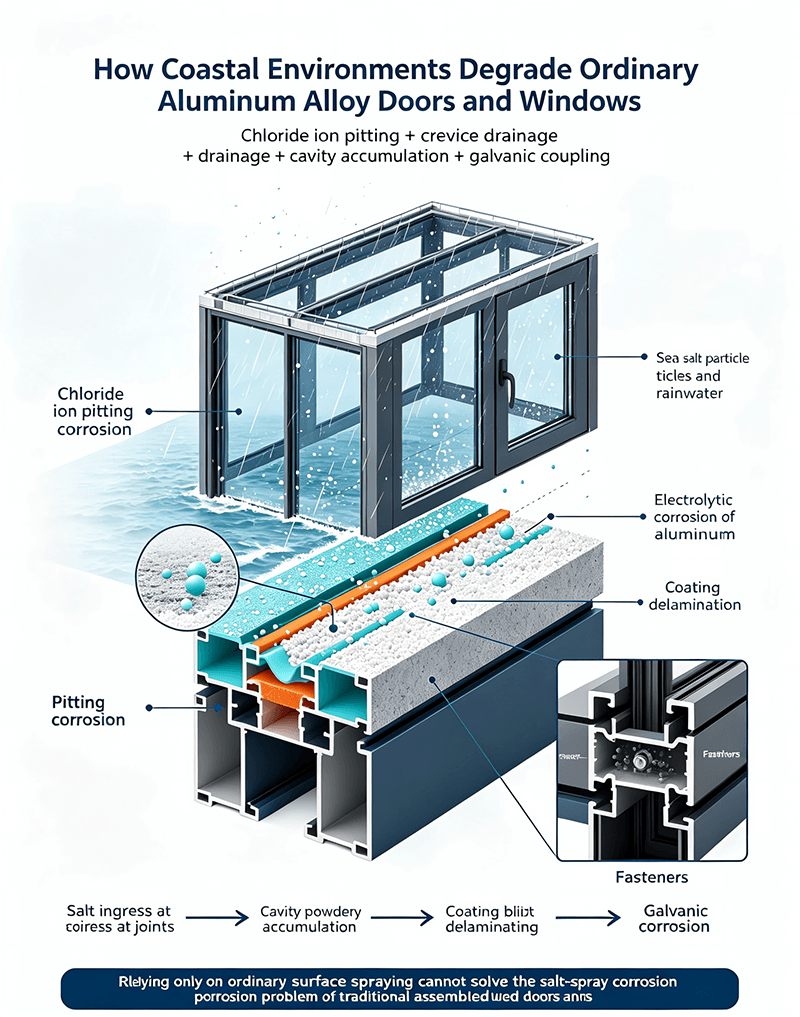
Aluminum forms a natural oxide layer that resists corrosion in normal air. But coastal air carries chloride ions — the active ingredient in sea salt. Carried inland on the wind and deposited on every surface, these ions dissolve in dew and rain into a conductive electrolyte that punches through the protective film and triggers pitting and crevice corrosion.
Most standard thermal-break aluminum windows are built with 45° cut corners joined by mechanical corner keys and a bead of sealant. Those corner joints are never fully sealed. Under daily thermal movement and the positive/negative pressure of coastal storms, the sealant ages, micro-cracks and loses adhesion — opening capillary channels that pull salt water and spray deep into the frame’s hollow chambers. The damage then compounds:
- Hidden chamber corrosion: Salt water that enters the cavity cannot be rinsed out by rain. In the wet–dry cycle, salt concentrates and corrodes the inner walls, leaving the white, powdery aluminum salts you see blooming at the corners.
- Coating failure from within: Internal corrosion expands and pushes the outer powder coating off the substrate, causing blistering, peeling and bare-metal exposure.
- Loss of structure and sealing: Corroded corners lose rigidity, shift out of square and widen the very joints that let water and air in — driving leakage, drafts and failing insulation.
- Galvanic corrosion of hardware: Aluminum, steel corner keys and low-grade fasteners form a battery in salt air, accelerating the rust and seizure of hinges and locks.
The most dangerous coastal failure is invisible: the exterior still looks fine while the inside of the frame is already rusting — irreversible structural damage. A thicker coat of paint alone cannot fix a window that was born with a seam.
Three Engineering Fixes for Coastal Corrosion
A durable coastal window attacks corrosion on three fronts at once — the joint, the cavity and the surface. Together they form a closed-loop defense system.
1. Seamless Welded Corners — Remove the Seam, Remove the Risk
Surface coatings are passive defense. The real fix is to eliminate the structural seam. Instead of mechanical corner keys, the frame corners are laser-fused so the profile ends melt and bond at the molecular level, then finished to a smooth, safe R-radius corner and coated as one continuous piece.
With no original joint, there is no channel for salt spray or rain to enter the cavity. The welded corner is also structurally stronger than a keyed joint, so it resists the repeated storm-pressure deformation that opens secondary micro-cracks — holding its seal, season after season. This is the foundation of a seamless welded coastal window.
2. Full-Cavity Polyurethane Foam Fill — Starve the Corrosion
Most windows stop at keeping water out. They miss the slow damage from trace moisture and trapped salt inside the chamber. A high-density, closed-cell polyurethane is injected in liquid form to fill 100% of the multi-chamber profile — no voids, no gaps, no loose points. For the coast, that delivers three things:
- Locks out water and salt: Closed-cell foam hardly absorbs water and stores no salt. Even if trace moisture gets in, it cannot flow and concentrate, so internal salt-corrosion cannot take hold.
- Stops corrosion from spreading: With no empty space, salt and vapor cannot migrate through the chamber and turn a small pit into widespread decay.
- Adds rigidity: A foam-filled chamber is stiffer and more wind- and impact-resistant, reducing the micro-movement that breaks seals.
Note: Full-cavity fill is internal reinforcement — it works with, not instead of, a proper drainage system. The window keeps its weep holes, so the design stays “block + drain,” never trapped water.
3. Double-Coat Powder Coating — Primer Seals, Topcoat Survives
Many suppliers apply a single weather topcoat and skip the transition layer between metal and paint. In high-chloride, high-UV coastal air, that single layer loses adhesion and permeability fast. A two-layer powder coating system closes the gap:
- Corrosion-resistant primer: Bonds tightly to the aluminum, seals microscopic pores, and forms a dense barrier that locks the topcoat in place and blocks water and chloride ions from reaching the substrate — preventing electrochemical corrosion and pitting at the source.
- High-durability powder topcoat: Built for outdoors — it resists UV breakdown, salt spray, rain and abrasive wind-blown sand, holding color and gloss far longer than standard finishes.
Together: primer for sealing and adhesion, topcoat for weathering and looks. Versus a single coat, the system sharply improves how the profile performs and how long it lasts in hostile environments.
Match the Coating to the Coastline
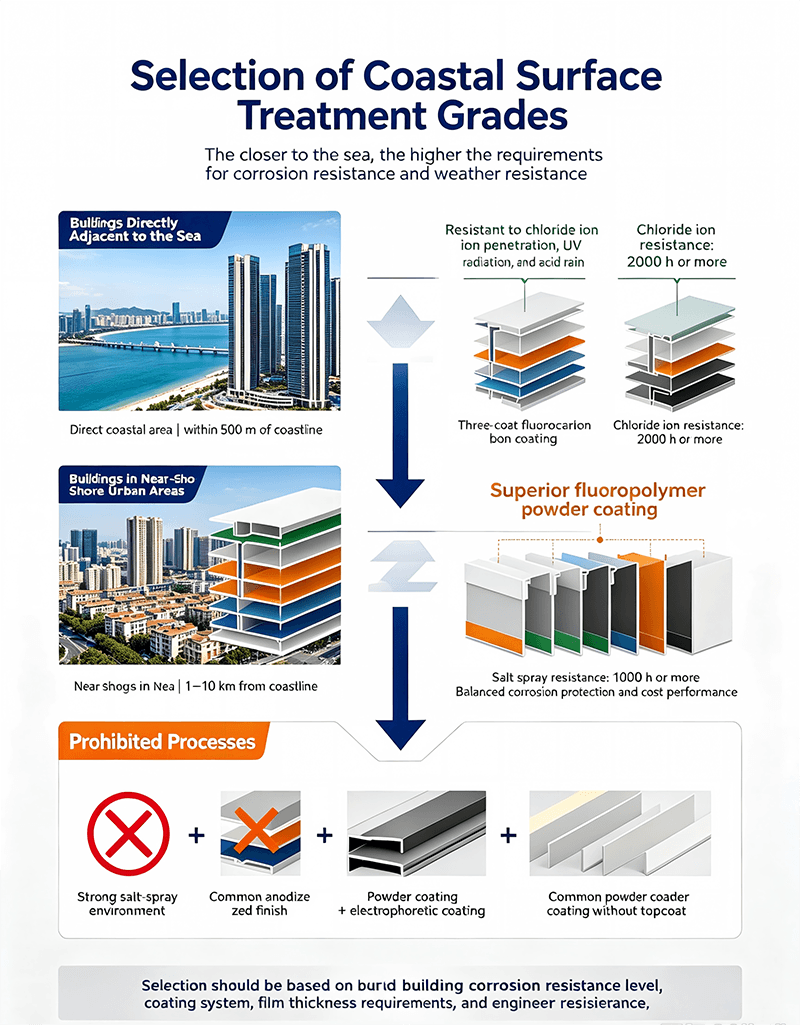
Spec the finish to the site. Distance from the shore decides how much protection you need — and how to balance performance against budget.
| Zone | Distance from shore | Recommended finish | Salt-spray resistance | Notes |
| Front-line coastal | Within 500 m | Fluorocarbon (PVDF), 3-coat / 2-bake | 2,000 h+ | Best-in-class against chloride, UV and acid rain. Use genuine fluorocarbon, control film thickness, avoid look-alike substitutes. |
| Near-coast urban | 1–10 km | Super-durable polyester powder | 1,000 h+ | Strong weather and corrosion resistance at a better value; suits buildings not facing direct sea wind. |
| Not for coastal use | Any coastal / near-coast | Standard anodizing, standard electrophoretic, interior-grade powder | Poor | Fails fast under chloride attack — pitting, darkening, white bloom. Prohibited on all coastal windows & doors. |
Keep Them Performing — A Simple Maintenance Routine
Premium engineering cuts corrosion risk sharply, but no window is maintenance-free forever. A light, regular routine protects the investment:
- Rinse off the salt: Within 500 m, rinse frames with clean water and a mild neutral cleaner every 3 months; 1–10 km, every 6 months. Never use strong acid/alkali cleaners, steel wool or high-pressure close-range spray that can damage the coating.
- Care for the hardware: Every 3 months, wipe salt off hinges and locks and apply a light protective oil to extend their coastal life.
- Annual inspection: Once a year, clear weep holes of debris, algae and dust to keep drainage open; touch up any chipped or scratched coating with matching weather-resistant paint before pitting spreads; replace aged or cracked seals and gaskets; and lubricate hinges and lock points with a corrosion-resistant grease (not ordinary oil, which attracts salt).
A Closed-Loop Defense for Coastal Windows & Doors
Coastal salt damage is never one thing — it is chloride attack, moisture ingress, seam-driven wicking and salt concentration working together. The structural seam in a traditional window is the weak point that lets all of it in. By fusing the corners (seamless welded), filling the chambers (full-cavity foam fill) and protecting the surface (double-coat powder coating), a coastal window turns those weak points into strengths. Pair that with the right finish for the distance to shore and a simple upkeep routine, and aluminum windows & doors can hold their structure, appearance and watertight, leak-proof performance for years in salt, humidity, wind and sun — real durability for real coastal cities.
Post time: Sep-16-2026


